The village of Vaiges (pop. about 1,200) is perhaps 10 minutes' drive from my very own St Pierre sur Erve (pop. about 150). About halfway between the two places is a big quarry, an open-cast limestone mine. This is a boon for Vaiges, since the quarry lies within their boundary, and it pays quite a lot of tax. This to the extent that, according to our mayor, their council has about 440,000 euros to spend each year; that takes some serious spending on a population of 1200. Surrounding villages are enviously eyeing this wealth, and proposals for reducing local government costs by combining small communities are being actively debated.
The town hall (le mairie) looks very fancy, and the gardens have recently been landscaped and redone. There is a new car parking area beside it, and the street lamps are new, and illuminated at night with little LED rings at about chest height so that semi-blind people don't walk into them. The salle socio-culturelle (village hall/community centre?) has also been done up recently. It now features a fancy professional kitchen with all mod cons, and a new stage/theatre, with bar, lighting, sound system; everything you could want except, it would seem, air conditioning.
It is here that my dairy farming and guitar-playing friend Alain, and his troupe, perform their annual amateur dramatics offering. Last night was the last night and we went along to see. The evening starts with offerings from the younger performers, sometimes a short play, this time with a series of comedy sketches. Then the main event, a comedy about a French camping holiday site, featuring various figures recognisable from the local community. It's fun to spot the local personalities. There's Alain, of course, and the lady who works in the supermarket. Plus the one-armed garden nursery manager, the trumpet-player and the flute-player.
There's a tombola at half time, with crêpes, beer and other delights on sale, and an opportunity to mix with the people you recognise. And I won a very fine Easter cactus in a pot. These kinds of plants do well in the conservatory, and I have various shades of red, but no pink-and-white. Cool.
In the end, it's a fun, if rather warm, night out. And even though my French isn't up to following all of the rapid-fire dialog, nor catching all the jokes, I can still grasp the plot. But as a fund-raiser for the school, it's a great way to contribute and be entertained at the same time.
Saturday, 21 February 2015
Sunday, 15 February 2015
Je suis un lapin
The owner of the mill in the village has been improving the site, trimming hedges and cutting down some of the trees. In the spirit of support for Charlie Hebdo, one of the trunks was left standing and carved into a pencil. The guy who lives just down the road from this assures me that his own artistic carving is of a rabbit.
Thursday, 12 February 2015
Destruction
I was talking to our ex-mayor not long ago, about, amongst other things, the recent closure of one of the two bakers in our local village. The owners have retired, but they can't sell their shop, he explained.
Now it's not really surprising that the shop would be hard to sell: the one next door has been for sale for all the time we have been here; getting on for 8 years. But this one in particular (he told me) has also been hit by an update to the norms that apply to bakeries.
Norms abound in France. They are government-imposed specifications that range from the size and content of school dinners for children of different ages, the weight and height-of-fall of children that a swimming pool cover must withstand, to what we would call building regs. The norms have legal status.
In this case, (as I understand it) our baker used to make the dough in a building separate from his oven; across the street in fact, and carried the resultant unbaked loaves between the buildings to be baked. I guess he covered them with something to keep the dust off them in this short journey, but I don't know. Anyway, the norms now say you mustn't do this.
When a new norm comes into being, it's often not applied to existing premises, but takes effect when there is a change of ownership or major renovations. As a result, our baker was happily baking bread that people were buying and eating, with, as far as I am aware, no ill effects, but now he's gone, the premises can no longer be used as a bakery. And I'm willing to bet that the sale value of the shop reflects this.
P.S. As an aside, many villages, including my own, had a central, communal bread oven, and when it was fired up, the women of the village would carry their dough loaves (through the village, in the open air), to get them baked. And what's wrong with that?
Now it's not really surprising that the shop would be hard to sell: the one next door has been for sale for all the time we have been here; getting on for 8 years. But this one in particular (he told me) has also been hit by an update to the norms that apply to bakeries.
Norms abound in France. They are government-imposed specifications that range from the size and content of school dinners for children of different ages, the weight and height-of-fall of children that a swimming pool cover must withstand, to what we would call building regs. The norms have legal status.
In this case, (as I understand it) our baker used to make the dough in a building separate from his oven; across the street in fact, and carried the resultant unbaked loaves between the buildings to be baked. I guess he covered them with something to keep the dust off them in this short journey, but I don't know. Anyway, the norms now say you mustn't do this.
When a new norm comes into being, it's often not applied to existing premises, but takes effect when there is a change of ownership or major renovations. As a result, our baker was happily baking bread that people were buying and eating, with, as far as I am aware, no ill effects, but now he's gone, the premises can no longer be used as a bakery. And I'm willing to bet that the sale value of the shop reflects this.
P.S. As an aside, many villages, including my own, had a central, communal bread oven, and when it was fired up, the women of the village would carry their dough loaves (through the village, in the open air), to get them baked. And what's wrong with that?
Tuesday, 10 February 2015
Toilet humour
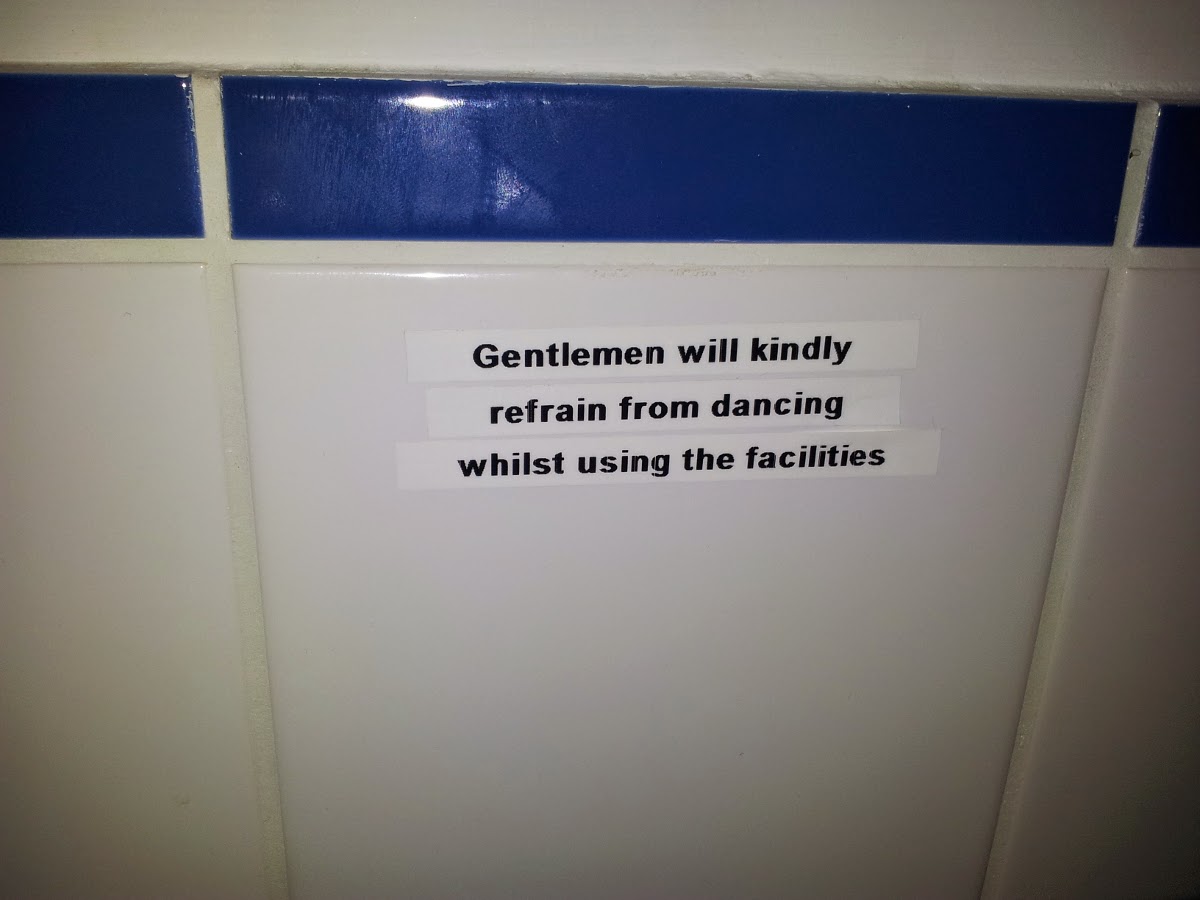
The disabled persons' toilet in our local music school has a disco in it. No kidding: when you go in, different coloured strobes start to flash, a glittering ball spins and disco music plays. As I reflected on the implications of this for wheelchair-bound people, it struck me that for me, anyway, dancing at the same time as using the toilet for its usual purpose would be a bad idea.
The trouble is, I was then asked when one uses "whilst" as opposed to "while". Tricky one, that.
Friday, 6 February 2015
Missed
One of the aspects of running a gîte, that we didn't really grasp before taking it on, is the obvious (in hindsight) fact that people come when they aren't working, i.e. at weekends or holiday times. And when most people who are not employed in the hospitality business are not working, most people employed in the hospitality business are up to their necks in it. Since most customers come for weekends, this fact tends to screw up our weekends.
Mostly this is not too much of a problem. So sometimes I miss performing at a concert, or I miss going to one from time to time. No big deal. But just occasionally something crops up that is significantly annoying to miss, to whit the invitation above, to an event where my fine nephew is marrying the equally fine lady who has borne him his equally fine daughter.
Merde.
Friday, 23 January 2015
Arc welding
I have a problem with plant stakes. In the springtime I plant my plants, whatever they are, and if I think it necessary, I put stakes in the ground next to them so that I can tie them up when they get bigger, so they don't flop around and fall to the ground. This technique doesn't work. Usually, I just forget to tie up the plants, or else I arrive too late and the plant has already flopped earthwards.
What I need is to get out earlier, be more diligent, or better still, use plant supports that surround the plants so they don't have to be tied. There are commercial ones of these available, but I can't bring myself to pay upwards of two quid for a piece of bent wire, even if it is covered in green plastic to make it look nice. Especially as I need 40 or so of them.
So I have been looking for alternatives. I spotted, in a municipal park, a couple of years ago, quite a nice system. It looked like a students' engineering project, and comprised a horizontal metal grille about a metre across, with a ring in the middle that was slid onto a vertical stake, and clamped to it with a bolt. I reckon that I can make something similar using the cheapo steel grilles and bars used for reinforcing concrete, as long as I can find a method of joining the grille to a vertical stake.
Hence the arc welding.
I don't know much about arc welding. All I know is that many years ago, my Dad, who was a teacher at a tech college, had a go at it. I am guessing that he looked at the calibre of students doing the arc welding course there, and concluded that any fool can be an arc welder. He came home one day with a huge and heavy welding transformer borrowed from the college, and a bunch of iron rods of different cross-sections, and announced that he was going to make a bed headboard.
The air in the garage was two-colours bright for a while; white from the arc welding, and blue from the swearing. Over time, the welding transformer disappeared back to the college, the iron went to wherever iron goes to die. Nothing was said.
On the other hand, how hard can it be? And I only want plant stakes.
Louis is a French paysan (it translates to "peasant" in English, but has no derrogatory connotations in French; "countryman" might be better) who lives down the road from me, and does his own arc welding. He promised to show me how it's done if I got the necessary equipment.
As it happend, our local DIY (Leroy Merlin) had a bunch of modern inverter-based welding kits, complete with the eye-protecting screens, on special. I got one, along with some iron reinforcement material for concrete, to make the plant supports.
The inverter is small and light, easy to carry, and the helmet is electronic: it has an LCD screen that is normally almost clear, but that blanks out to almost opaque in a few milliseconds, in response to welding light. This makes it a lot easier to use than the old style filters that you can only see anything through when the arc is burning. It's powered by solar cells, and they suggest you put the helmet in the sun for several minutes before using it. I took the whole lot round to Loui's place this morning and we had a go at making a plant stake.
Here is a picture of the stake, and also a close-up of the join that needs to be welded.
And here's the finished product. What a masterpiece! Can you see the smooth, professional-looking weld? Nor can I. And there's a bit where the metal of the square frame is almost burnt away. But in the end, it's a plant stake - aesthetic appeal is optional. And I am hoping that by the time I have made 40 of them I will have gained a useful skill. And some plant stakes. And a welder.
What I need is to get out earlier, be more diligent, or better still, use plant supports that surround the plants so they don't have to be tied. There are commercial ones of these available, but I can't bring myself to pay upwards of two quid for a piece of bent wire, even if it is covered in green plastic to make it look nice. Especially as I need 40 or so of them.
So I have been looking for alternatives. I spotted, in a municipal park, a couple of years ago, quite a nice system. It looked like a students' engineering project, and comprised a horizontal metal grille about a metre across, with a ring in the middle that was slid onto a vertical stake, and clamped to it with a bolt. I reckon that I can make something similar using the cheapo steel grilles and bars used for reinforcing concrete, as long as I can find a method of joining the grille to a vertical stake.
Hence the arc welding.
I don't know much about arc welding. All I know is that many years ago, my Dad, who was a teacher at a tech college, had a go at it. I am guessing that he looked at the calibre of students doing the arc welding course there, and concluded that any fool can be an arc welder. He came home one day with a huge and heavy welding transformer borrowed from the college, and a bunch of iron rods of different cross-sections, and announced that he was going to make a bed headboard.
The air in the garage was two-colours bright for a while; white from the arc welding, and blue from the swearing. Over time, the welding transformer disappeared back to the college, the iron went to wherever iron goes to die. Nothing was said.
On the other hand, how hard can it be? And I only want plant stakes.
Louis is a French paysan (it translates to "peasant" in English, but has no derrogatory connotations in French; "countryman" might be better) who lives down the road from me, and does his own arc welding. He promised to show me how it's done if I got the necessary equipment.
As it happend, our local DIY (Leroy Merlin) had a bunch of modern inverter-based welding kits, complete with the eye-protecting screens, on special. I got one, along with some iron reinforcement material for concrete, to make the plant supports.
The inverter is small and light, easy to carry, and the helmet is electronic: it has an LCD screen that is normally almost clear, but that blanks out to almost opaque in a few milliseconds, in response to welding light. This makes it a lot easier to use than the old style filters that you can only see anything through when the arc is burning. It's powered by solar cells, and they suggest you put the helmet in the sun for several minutes before using it. I took the whole lot round to Loui's place this morning and we had a go at making a plant stake.
Here is a picture of the stake, and also a close-up of the join that needs to be welded.
And here's the finished product. What a masterpiece! Can you see the smooth, professional-looking weld? Nor can I. And there's a bit where the metal of the square frame is almost burnt away. But in the end, it's a plant stake - aesthetic appeal is optional. And I am hoping that by the time I have made 40 of them I will have gained a useful skill. And some plant stakes. And a welder.
Tuesday, 20 January 2015
Yamaha concert
Yamaha make musical instruments, amongst other things. I played on one of theirs for several years when I was starting to learn the flute, but graduated onto other brands as my playing improved. This is a common enough story, but probably represents a nightmare for Yamaha marketing people. Many people perceive their instruments to be great for beginners/intermediate players but not for professionals. Yamaha do also make top quality instruments played by professionals, but perhaps brand loyalty doesn't work in the same way as it does for, say, motor bikes.
My local flute repair shop is L'Atelier D'Orphée in Le Mans, and I have had my flute repaired and serviced there a few times. They are a Yamaha dealer. (The boss, Gérard Klein, is a flute player.) I'm on their mailing list, and I was surprised a few weeks ago to get their email telling me they had 47 tickets available for a free concert in Paris, transport laid on, sponsored by Yamaha, first come first served. I was delighted to get a couple of tickets for us both to go.
It was last night. We bundled onto a coach at Le Mans at 4:30 pm, about 3 hours' drive into the centre of Paris where we were dropped off just outside the Theatre des Champs Elisées. The concert was given by La Musique des Gardiens de la Paix, i.e. the Paris police harmonie band. Good they were, too. They started with Sibelius' Finlandia, and moved onto some lesser-known composers, and featured solo performances on flute, trumpet, and a clarinet duo who were extraordinarily good. A fabulous concert. And if Yamaha took the opportunity to point out that certain musicians, including some high-powered international musicians, play on Yamaha instruments, well, who can blame them.
A bit of a late night. Coach at 11pm, Le Mans at 1:40, in bed at 2:30. Some people apparently, came from much farther away. I'm sure they thought it was worth the trip, too.
My local flute repair shop is L'Atelier D'Orphée in Le Mans, and I have had my flute repaired and serviced there a few times. They are a Yamaha dealer. (The boss, Gérard Klein, is a flute player.) I'm on their mailing list, and I was surprised a few weeks ago to get their email telling me they had 47 tickets available for a free concert in Paris, transport laid on, sponsored by Yamaha, first come first served. I was delighted to get a couple of tickets for us both to go.
It was last night. We bundled onto a coach at Le Mans at 4:30 pm, about 3 hours' drive into the centre of Paris where we were dropped off just outside the Theatre des Champs Elisées. The concert was given by La Musique des Gardiens de la Paix, i.e. the Paris police harmonie band. Good they were, too. They started with Sibelius' Finlandia, and moved onto some lesser-known composers, and featured solo performances on flute, trumpet, and a clarinet duo who were extraordinarily good. A fabulous concert. And if Yamaha took the opportunity to point out that certain musicians, including some high-powered international musicians, play on Yamaha instruments, well, who can blame them.
A bit of a late night. Coach at 11pm, Le Mans at 1:40, in bed at 2:30. Some people apparently, came from much farther away. I'm sure they thought it was worth the trip, too.
Subscribe to:
Posts (Atom)