Wednesday, 11 July 2012

Slow-worm

This slow-worm appeared the other day, by my veg patch as I was working.   Although they look and move like a snake, they are legless lizards.   If you try to hold them by the tail, it will break off, and the slow-worm will wriggle off to freedom.  And they move very fast.

Nowadays I don't touch them; they're getting rare, and are best left to their business.   But when I was younger I caught them and took them home to put them on the compost heap to eat the snails.  So if you really must pick one up to stop it going onto a busy road, for example, grab it quickly, gently and firmly just behind the head, and hold it at arm's length and look the other way.  Because it will writhe like crazy and spray you with excrement. It is easy to let go at this point, but if you drop it onto grass you will not catch it again, they are so fast.  Once it's finished writhing it will become calm and you can move it to safety.

They are instantly recognisable because their skin is quite shiny, glistening, and has distinctive colour: black sides with a fawn top, and a thin black stripe down the middle.  The head too doesn't widen out like a snake's; it looks, if anything, a bit like a blunt pencil end.

They eat garden pests, including slugs and snails, and are generally good for the garden.  They especially like to live in compost heaps, which is why you should be careful when digging in one, or turning it over.


Tuesday, 10 July 2012

Le Puy en Velay

Our last port of call in the Auvergne was le Puy-en-Velay.  A pretty town built around a cathedral on a hilltop. We started Saturday with a visit to the market, a thriving affair with the whole world there, buying, sitting drinking the first morning glass of wine, pausing for coffee or nattering, generally doing the French market thing.  I woke myself up with a 15 megawatt coffee, very effective.


The cathedral is an impressive affair, worth a visit and worth the walk up the steep hill too. You can also visit the local volcanic needles that jut out of the ground and the view of Puy cathedral above is taken from one of those nearby (below).


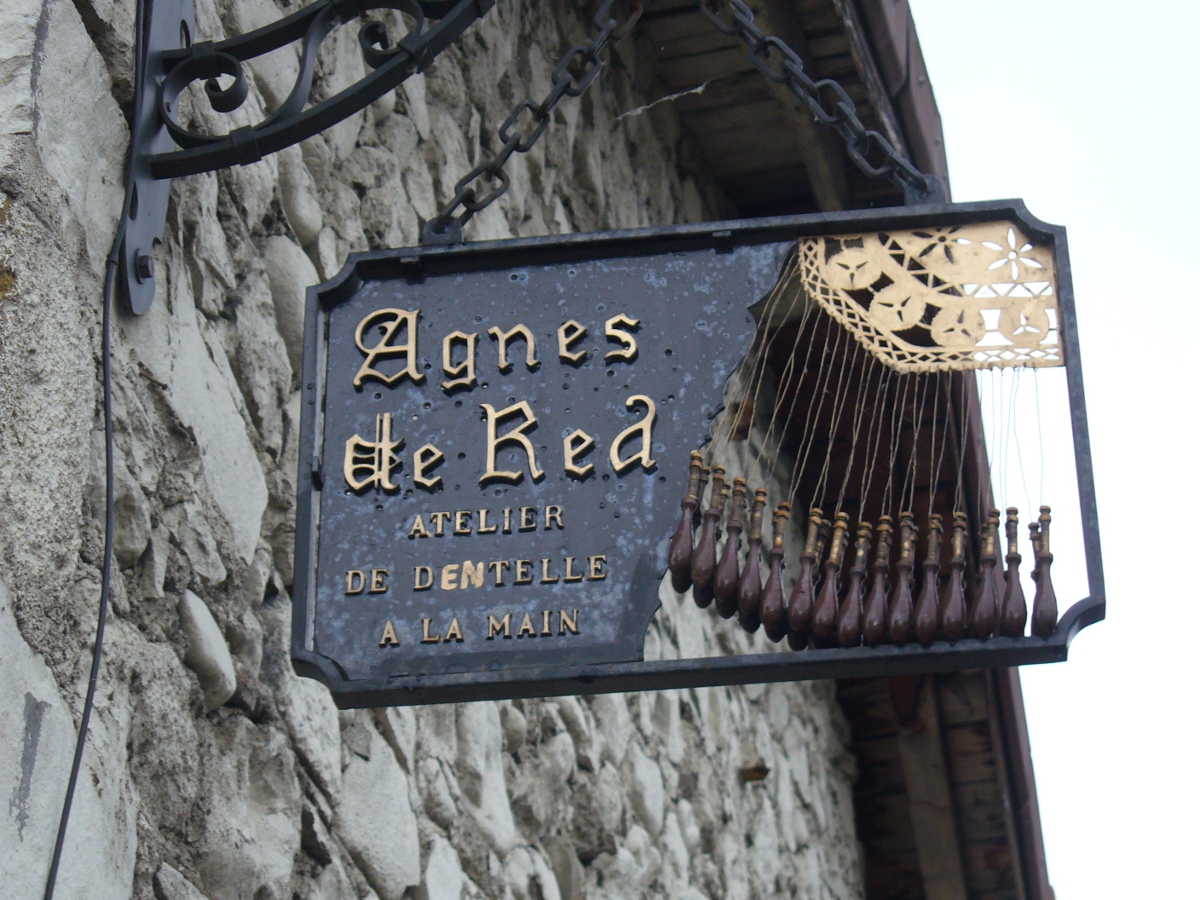
Puy-en-Velay has two main claims to fame: lentils and a travel book.  Oh yes, and lace, but that's pretty much died out.  Lentilles de Puy are a locally-grown speciality, awarded an A.O.C and generally regarded, at least in Puy, as a little bit special: there is something about the fertile, volcanic soil, the clarity and colour of the light, the ideal winds, rainfall and temperatures, and the special texture and aroma of the local bullshit that all come together to make lentilles de Puy a product that is unequaled anywhere else.

Not that I'm against the idea of an A.O.C in principle.   Champagne was in danger of becoming a generic term for fizzy white wine, until the producers stamped their feet.  But you can take things too far: you can't even describe fizzy white wine that has been produced using the methods traditionally used to make champagne, as "méthode champenoise", you have to describe it as "méthode traditionnelle".   This is all very well but if won't help you if the Aussies (or the Brits even), start making something better and cheaper, and people, strapped for cash, start looking at value rather than cachet.  That could be now.

The other claim to fame arises from a visit by Robert Louis Stevenson (of "Treasure Island" fame), who wrote a book based on his hiking trip in the area, entitled "Travels With a Donkey in the Cévennes".  It's turned into a nice little earner.  There's a local society that promotes and classifies accommodation along his route; you can hire donkeys to walk the route with you, and various guide books are available for purchase to help you on your way.  Apparently it's impossible to get lost on the route these days; you just follow the trail of donkey droppings.

There is a special "donkey-friendly" label that you can apply for if you can accommodate both donkeys and people overnight.  The criteria (for the donkey part) are as follows:
       * There must be an easy-access, protected, hazard-free area of at least 50 square metres for the donkey, no more than 1km away from the accommodation.
       * There must be good quality hay and barley for the donkey, and a block of salt.  (Requirement for AOC not specified), and drinking water.
       * There must be somewhere to securely store donkey saddles, etc, overnight.

And fortunately for us, the guide books are able to correct the more obvious mistakes made by Mr Stevenson, arising, evidently, from his Presbyterian background and general poor taste.   He doesn't mention the wonderful architecture of Le Puy en Velay at all (because, although he passed through it before he started his trek, he didn't go there with the donkey) but the guide book starts us from there so we can correct this oversight.  All he commented on, apparently, in a note to a friend, was the lousy meal he was served at Puy (should have tried the lentils, obviously).

And he doesn't mention the pretty Auvergne ladies until about 2/3 the way through his trip.  Although this was probably due to the fact that he was pining for his girlfriend who had cleared off to the USA, and he was getting his emotions in order, we are guided to the conclusion that this was down to his Presbyterian upbringing.  Thank heavens for good ole Catholicism, eh?


Lacemakers and UFO spotters, both harder to find these days in Puy.

Sunday, 8 July 2012

Lafayette

From the area around Puy de Dôme, on South towards Le Puy en Velay, by means of a meandering route through wonderful views, and via a little museum dedicated to general Lafayette, set up in his place of birth. 

He was a French politician and warrior who, as well as fighting for the French revolution, helped the American army during the American revolution.  Thanks, pal. 

What I liked about this museum is that it doesn't shrink from publishing comments about him by his enemies and detractors, so you come away with a more rounded idea of the person than is usual.  It has a nice garden too, not too big, but with old trees and pleasant views.  The Acer palmatun dissectum was at least 7 feet high, it must be several hundred years old.


Thursday, 5 July 2012

Holiday snaps

There is plenty of countryside in the Auvergne to see and walk through, far more than I can do justice to with photographs and blog posts.  Before we left the area of Clermont-Ferrand and in addition to the Puy de Dôme, we walked through woods, along a stream, had some good food (L'âne gris did me a nice lunch in Riom), and a generally nice and relaxed time.


Tuesday, 3 July 2012

Puy de Dôme

If you are in the area and the weather is even halfway decent, a visit to the Puy de Dôme is a must.  Its peak is at 1,465 metres,  and it offers spectacular views over the surrounding countryside.

It was a hot day, 32 degrees or so in the afternoon, so we took the train up to the peak.   This left us with plenty of energy to explore the summit, you can walk round it, take in the chains of volcanoes stretched out below you, you get a distant view of Vulcania (the best way to see it, in my opinion) and of Clermont-Ferrand some 15Km to the East.

There was a gentle wind blowing, just enough for paragliders to be able to maintain height, or gain some with a bit of skill and luck.   They dotted the sky with their coloured wings, and since we have both done a little in the past, we were able to appreciate and enjoy watching their technique.

Incidentally, there is a little monument to a prize-winning flight that was made from Paris to the top of the Puy de Dôme in 1911, in a time of under 6 hours.  The feat was thought to be impossible, and the prize of £4,000 was a considerable incentive.  A bit like the X-Prize today.
 
The sites at the top and bottom of the mountain, and the train itself, have recently been redeveloped using a budget of nearly 97 million Euros of taxpayers' money.   The site isn't completely finished yet, but the new modern rack-and-pinon electric train that takes you to the top is in service.  The information panels tell us that using careful energy management, the train coming down provides half the electricity needed by the train going up, which would be a good thing, except there was only one train on the track.

The train ran once per hour, and took about 15 minutes or so to reach the top, where it waited for 15 minutes before coming down again.  So you could be waiting up to 45 minutes for the train, and guess what there wasn't any of, on the platform, for waiting passengers?  Yep, seats.  Well in truth, at the bottom station there were three folding chairs that looked like they had been bought on expenses at Super-U or the like.   It seems to me that the people who are most likely to want to take the train are those who are least able to make the 45-minute hike up to the top, so would be the most in need of a chair.  Who designs this stuff?

The main holiday season starts in July and we were there in the off season, towards the end of June.  The train, when it set off, was nevertheless full, with passengers standing in the aisles  because all of the seats were taken.  I think they have a capacity problem.  The train was as long as could be accepted by the platform, so it can't be made any bigger without big structural changes, but it could probably be split into two, since there were 4 carriages I think, and there was a passing place halfway up the mountain to allow trains to cross each other.  But running trains of half the size every half hour instead of one big one every hour doesn't increase the capacity at all; I think the best they would be able to manage is to run the trains every 20 minutes, an increase in capacity of 50%.  Doesn't look like enough to me.

There was no air conditioning in the train, and in 32 degree outside heat, with big glass windows, it got hot.  The platform at the bottom was open to the air, the platform at the top was enclosed, and was air-conditioned.   So people catching the train down would get on the train, bake for a bit, decide it was better on the platform, and go out again to sit (on the floor, of course) before getting back on the train again just before it left.

I'm starting to think that France doesn't "do" tourism.  I'll elaborate on this theme, some time when the muse takes me, and I've thought about it a bit more.


Monday, 2 July 2012

The Auvergne

We had enough time between guests for a quick trip to the Auvergne, a part of France focused on the Massif Centrale and famous for its volcanic landscape and mineral water (not forgetting the lentils, A.O.C, naturally).

We had heard about Vulcania, the exhibition/museum/theme park about volcanoes, so that was the first stopping point as an orientation excercise, and the nearby Puy du Dôme is the highest point in the volcanic system, so that was the second.   There's not much point in my telling you what Vulcania is; they have a website here that explains things quite well, and in English too.  I can give you my impression of the place though, which is that I was underwhelmed.  We both were.  Not much whelming going on at all.

Perhaps the fundamental problem is that there isn't actually any real volcanic activity going on that you can see, and no amount of translucent plastic with red lights shining through it can disguise this fact.  Sure it's possible to make a museum, and to show real layers of now-cold lava flow, and to have rides that evoke some aspects of the experience of volcanoes, but none of it, none at all, is happening, volcanic action.

So you have a combination theme park, museum and exhibition about volcanoes.  The theme park rides were of the "moving platform" type that shake you about while you watch a film.  They spray you a bit in the wet bits and one had infra-red lamps so you feel hot when looking at molten lava.  And the 3-D dragons were cute, but not much to do with volcanoes.

There was a fountain that they call the geyser, that by pushing buttons you can make do different things to illustrate geyser-type activity, but at the end of the day, it's a fountain.

The VulcanBul is an autonomous car, illustrating the "car of the future".  Battery-powered, driver-less, and steered automatically by GPS, it is covered in what I think is perspex so you get a clear view of the outside.  It goes at about 3 MPH, and a commentator, who could also be driving if it was drivable, tells you what it is you're looking at.   But according to the description, it doesn't run in bad weather, which seems to me to be the time when one would most appreciate a ride outside and under cover.  I don't know if this is because the technology doesn't work in the rain, or if it's because of some management policy, but it struck me that they'd have been better off with a horse-drawn buggy.   Probably more representative of the car of the future, too.

We were told to allow a whole day for the visit, which is probably necessary in high season if you want to do all the rides, because there were Disney-esque queuing systems in place for use in times of high demand, that will delay your appreciation of the site.

Verdict:  Only if your kids are into geology or volcanoes, or it's raining and they're getting fractious (and they don't want to go on the VolcanBul).


Saturday, 16 June 2012

Strange plants

The Iris have finished flowering, so now is the time to split up the corms of those that have spread too far, and replant them.  I spent most of the day doing this.  On the way I noticed these two strange plants in the garden.  I think the first one is some kind of wild orchid, and I think the second one is some kind of fungus.  Anyone able to identify them for me?


Related Posts Plugin for WordPress, Blogger...