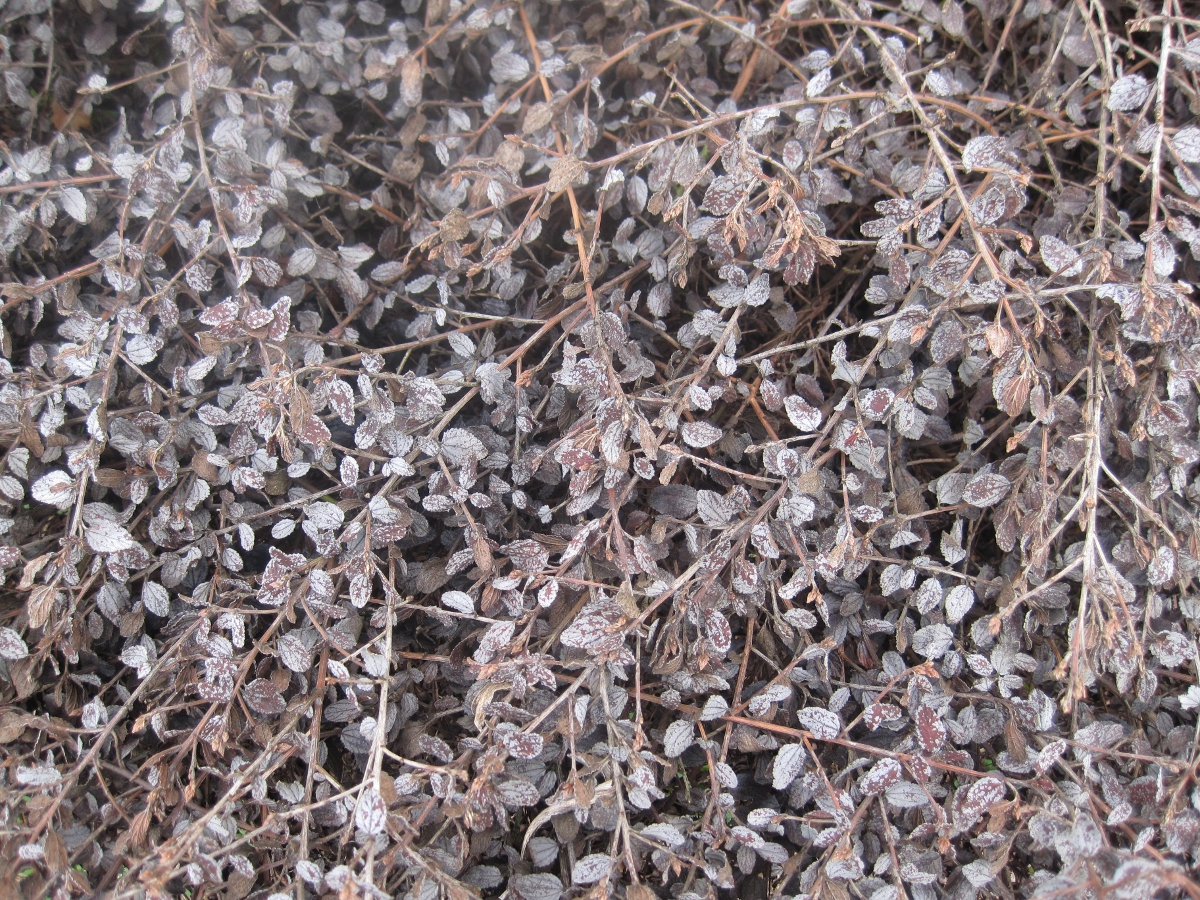
We had some chilly weather this Winter, with temperatures down to -15°C some mornings. Most of the time the ground was covered in snow, so there was some protection from the fiercest cold and strongest winds. None the less, all of the three Ceanothus plants dotted around show frost damage, and the little Bay tree will have to regrow from its roots again this year. I will move them both to more sheltered locations this Autumn (assuming that they have in fact survived) but I am running out of sheltered spots.
This cold was followed by a 4-5-week-long unseasonably warm spell that caused the garden to grow vigourously in February/March. This brought forward the daffodils, that were promptly clobbered by some sharp frosts. I didn't know that daffodils could get frost damage, I thought they were pretty resilient, but it weakened the flower stems so the flowers didn't open very well, and most of them fell over. The Canna lillies that somehow managed to survive in the ground also started sprouting, but their shoots too have died in the frosts. I am expecting them to recover though; the roots are clearly healthy and I am sure they will sprout again.
Meanwhile there is colour in the garden. These pansies are self-seeded, forming a cheeky carpet of flowers where they really shouldn't be. But who's complaining? The blue grass is a bit invasive, so I am going to have to move it, probably this Autumn. The Aubretias were grown from seed, and this clump comes from what was left in the seed tray after I had planted out all the "good" seedlings into their "right" places. And these wild cowslips are blooming at the foot of the big Walnut tree.
I am particularly pleased with this Broom plant, that seems to be establishing itself happily in its allotted place. Seeing how well it is doing, we bought two other Brooms this Springtime to plant elsewhere in the bed; a cream-coloured one, and a pink one. Apparently you can propogate them from semi-ripe cuttings so I will try that too, later in the year. Oh, and a free pic of the Photinia Red Robin that is finally managing to grow.
Sunday, 22 April 2012
Tuesday, 17 April 2012
Monday, 16 April 2012
Musical Weekend
It was the night of the Ste Suzanne Harmonie's Spring concert on Saturday night, in the church of Ste Suzanne.
A programme notable for its solos. We had a movement of a Mozart horn concerto, an Ave Maria by Caccini featuring a flute solo, and the theme from The Man In The Iron Mask, also featuring a flute solo. The Caccini solo was given by our newest 14yo flute player. A great chance for her to play to an audience, in front of a bunch of supporting musicians. Rare in England I think but not exceptional in France.
And on Sunday afternoon, an International Piano competition in Mayenne. Free to attend, so a great way to spend a Sunday afternoon listening to live piano performances. I even got the winner of the piano competition right. Can't be bad.
Thursday, 12 April 2012
One thing: Physics of fluting
This is my flute. Nothing too impressive to look at, sitting in its box, but I love to play it. This one is made by Stephen Wessel, a clarinetist, model aircraft enthusaist and metalworking artisan who lives in the South-West of England.
Stephen has chosen a selection of materials to make his flutes. The body is in solid silver, although you are not allowed to say so, since it's not hallmarked. The mechanism is in stainless steel for lightness and strength, and the keys are made of resin, again for lightness. The idea is that the lighter the mechanism, the easier it is to make it move and stop. I also like the combination of colours; silver, grey and black, altough they're not easily differentiated in the photo.
The flute is not a very efficient way of converting the energy of breath into sound. With a reed or brass instrument, all the energy of your breath ends up in the instrument, and is, at least in principle, available to be turned into sound. With the flute, you blow across the hole, and a lot of energy just dissipates into the surrounding air. Therefore the flute mechanism has to be very accurate; there is no room for leaks. Stephen hand-makes the screws on this flute with a fine pitch to their threads, so that the mechanism can be adjusted very precisely.
The flute makes a sound by being made to resonate as a tube that is open at both ends (see figure A below). This means that the lowest frequencey (the "fundamental") that the tube will resonate at corresponds to a sound wave twice as long as the tube. (The tube contains half a wavelength) Higher frequency resonances are possible, where the tube length is 2, 3, 4, etc half-wavelengths long. Figure B shows the tube resonating at the next highest available frequency (twice the frequency of the fundamental) where the tube is one wavelength (i.e. two half-wavelengths) long.
The range of the flute is three octaves, and this simple relationship between the length of the tube and the wavelength of the notes available means that the fingering for middle octave is almost the same as for the lowest octave. The fingering for the highest octave has broad similarities to the lower two. By contrast, reed and brass instruments resonate as a tube closed at one end and open at the other, so that the tube is 1/4 wavelength long, and the first harmonic available is an octave-and-a-half above the fundamental (the tube is then 3/4 of a wavelength long). (Figure C). The fingering for these instruments is correspondingly more complex, but the reflection of sound waves off the closed end of such an instrument is more efficient, making it easier to get them to resonate than the flute that lacks a closed end.
When you play a 3-octave flute, blowing a given length of tube will therefore, (with minor adjustments to fingering) give you three possible notes, each one an octave higher than the adjacent lower one. In between these octaves, the pitch of the note you play is set and adjusted by changing the effective length of the tube. The body of the flute is equipped with holes at various intervals, that are covered, as necessary, by keys. Holes are closed from the blown end progressively, creating a correspondingly longer and longer tube, generating lower and lower notes. The first hole that is open to play the note "C" is called the "C" hole, and the key that you use to close it to play a "B" is called the "B" key. Thus the "B" key covers the "C" hole, a confusion that is inevitable, like 19th century dates starting with 18.
The action of closing a hole is fundamentally different from opening it. If you tap a tube it will ring, (see, for example, tubular bells) and if you tap a key hard down onto the flute, the flute will ring to the corresponding pitch, even if you are not blowing it. One of the aspects of learning to play is to get a descending scale (where mostly you close holes) to sound as smooth as an ascending scale (where you mostly open them). What makes it worse is that if you slowly close (or open) a hole whilst blowing the flute, at one point the flute simply stops playing and you get a mish-mash of noise instead of a note. You have to close the hole quickly enough to avoid this, to get a smooth transition between notes, but not so fast that the key 'taps' the flute. The flute is not naturally a legato instrument.
The flute has an almost constant diameter along its length, a constraint that arises from the need to achieve good tuning across its three-octave range. A tube of a given diameter will resonate differently as its length changes. Another aspect of learning to play is to achieve a uniform tone across all the notes whether they are generated by a short tube or a long one.
Since it is a human trait to play musical intruments to the limits of human capability, and since flutes are less efficient than other wind instruments at converting energy into sound, it follows that they don't play as loud. They just about hold a place in a modern orchestra amongst much louder intruments, but the flutists often complain that they can't be heard. The flute doesn't play especially softly either, (most of the sound escapes the two ends of the tube rather than being reflected back down it to create the resonance) unlike say a clarinet that can make a sound on the threshold of hearing. It is a common complaint levelled at flutists that their music lacks dynamic contrast. Or any contrast at all in fact. Fair cop. It's hard to do, but can be done.
The flute has one key per finger, and you hold the flute such that each finger is right over its corresponding key. (Except the right-hand thumb that is used to balance the instrument, and the right-hand little finger that has three keys) With a few exceptions, every note on the flute can be achieved by moving one or more fingers no more than 2-3 mm, the distance necessary to move a key to close a hole. This is why the flute can give a flurry of rapid notes that is difficult for any other instrument to match. One aspect of learning the flute is the elimination of finger movement beyond that which is strictly necessary.
So why do I play this thing? It's hard to play loudly or softly, hard to play legato, hard to play in tune (more later), wastes breath and needs regular servicing to keep the delicate and precise mechanism in good order. Because I love the sound it makes. I make no special claims to skill, and it doesn't happen very often, but I have silenced a room full of talking people, and stopped people in their tracks, when making a noise with this thing.
Stephen has chosen a selection of materials to make his flutes. The body is in solid silver, although you are not allowed to say so, since it's not hallmarked. The mechanism is in stainless steel for lightness and strength, and the keys are made of resin, again for lightness. The idea is that the lighter the mechanism, the easier it is to make it move and stop. I also like the combination of colours; silver, grey and black, altough they're not easily differentiated in the photo.
The flute is not a very efficient way of converting the energy of breath into sound. With a reed or brass instrument, all the energy of your breath ends up in the instrument, and is, at least in principle, available to be turned into sound. With the flute, you blow across the hole, and a lot of energy just dissipates into the surrounding air. Therefore the flute mechanism has to be very accurate; there is no room for leaks. Stephen hand-makes the screws on this flute with a fine pitch to their threads, so that the mechanism can be adjusted very precisely.
The flute makes a sound by being made to resonate as a tube that is open at both ends (see figure A below). This means that the lowest frequencey (the "fundamental") that the tube will resonate at corresponds to a sound wave twice as long as the tube. (The tube contains half a wavelength) Higher frequency resonances are possible, where the tube length is 2, 3, 4, etc half-wavelengths long. Figure B shows the tube resonating at the next highest available frequency (twice the frequency of the fundamental) where the tube is one wavelength (i.e. two half-wavelengths) long.
The range of the flute is three octaves, and this simple relationship between the length of the tube and the wavelength of the notes available means that the fingering for middle octave is almost the same as for the lowest octave. The fingering for the highest octave has broad similarities to the lower two. By contrast, reed and brass instruments resonate as a tube closed at one end and open at the other, so that the tube is 1/4 wavelength long, and the first harmonic available is an octave-and-a-half above the fundamental (the tube is then 3/4 of a wavelength long). (Figure C). The fingering for these instruments is correspondingly more complex, but the reflection of sound waves off the closed end of such an instrument is more efficient, making it easier to get them to resonate than the flute that lacks a closed end.
When you play a 3-octave flute, blowing a given length of tube will therefore, (with minor adjustments to fingering) give you three possible notes, each one an octave higher than the adjacent lower one. In between these octaves, the pitch of the note you play is set and adjusted by changing the effective length of the tube. The body of the flute is equipped with holes at various intervals, that are covered, as necessary, by keys. Holes are closed from the blown end progressively, creating a correspondingly longer and longer tube, generating lower and lower notes. The first hole that is open to play the note "C" is called the "C" hole, and the key that you use to close it to play a "B" is called the "B" key. Thus the "B" key covers the "C" hole, a confusion that is inevitable, like 19th century dates starting with 18.
The action of closing a hole is fundamentally different from opening it. If you tap a tube it will ring, (see, for example, tubular bells) and if you tap a key hard down onto the flute, the flute will ring to the corresponding pitch, even if you are not blowing it. One of the aspects of learning to play is to get a descending scale (where mostly you close holes) to sound as smooth as an ascending scale (where you mostly open them). What makes it worse is that if you slowly close (or open) a hole whilst blowing the flute, at one point the flute simply stops playing and you get a mish-mash of noise instead of a note. You have to close the hole quickly enough to avoid this, to get a smooth transition between notes, but not so fast that the key 'taps' the flute. The flute is not naturally a legato instrument.
The flute has an almost constant diameter along its length, a constraint that arises from the need to achieve good tuning across its three-octave range. A tube of a given diameter will resonate differently as its length changes. Another aspect of learning to play is to achieve a uniform tone across all the notes whether they are generated by a short tube or a long one.
Since it is a human trait to play musical intruments to the limits of human capability, and since flutes are less efficient than other wind instruments at converting energy into sound, it follows that they don't play as loud. They just about hold a place in a modern orchestra amongst much louder intruments, but the flutists often complain that they can't be heard. The flute doesn't play especially softly either, (most of the sound escapes the two ends of the tube rather than being reflected back down it to create the resonance) unlike say a clarinet that can make a sound on the threshold of hearing. It is a common complaint levelled at flutists that their music lacks dynamic contrast. Or any contrast at all in fact. Fair cop. It's hard to do, but can be done.
The flute has one key per finger, and you hold the flute such that each finger is right over its corresponding key. (Except the right-hand thumb that is used to balance the instrument, and the right-hand little finger that has three keys) With a few exceptions, every note on the flute can be achieved by moving one or more fingers no more than 2-3 mm, the distance necessary to move a key to close a hole. This is why the flute can give a flurry of rapid notes that is difficult for any other instrument to match. One aspect of learning the flute is the elimination of finger movement beyond that which is strictly necessary.
So why do I play this thing? It's hard to play loudly or softly, hard to play legato, hard to play in tune (more later), wastes breath and needs regular servicing to keep the delicate and precise mechanism in good order. Because I love the sound it makes. I make no special claims to skill, and it doesn't happen very often, but I have silenced a room full of talking people, and stopped people in their tracks, when making a noise with this thing.
Thursday, 29 March 2012
Tuesday, 27 March 2012
The nerd factor
Like many boys and young teenagers I had an enthusiasm for models, and for flying; thus an enthusiasm for model aircraft. I built and flew various aeroplanes at the time, with varying degrees of success. A radio control system being beyond my wildest budgetary dreams, the planes were all "free flight" which meant they usually ended up in a tree, or disappearing over the horizon, never to be seen again. (If they flew at all, that is)
Later, I took my flying bug into flyng full-sized aeroplanes and gliders, followed by hang-gliders and parapentes. Although I was convinced at age thirteen that I was going to fly for a living, the passion never really bit beyond the level of enthusiasm, and I did different things with my working life. My interest in flying still remains, though, and now, having the means to acquire a radio control system, I have a couple of model aircraft that I fly from time to time when the weather and spare time permit.
Modern technology has advanced model aircraft a long way since I was a lad. It is nearly impossible to buy a "bad" plane: they are well-designed, and a model will, if correctly put together, usually do "what it says on the tin". The latest, lithium-polymer battery technology gives good power-to-weight, and combined with new, powerful ("brushless") electric motors, electric powered models are a realistic proposition. You can also buy models that are "Almost Ready to Fly", which means that instead of starting with a few sheets of balsa wood and heat-shrink covering, the main elements are already built: You just have to put the pre-built wings, tail, fuselage together, and add the electronics and mechanisms. This suits me fine, but one day I think I'll build one from scratch, like I used to.
I have little interest in aerobatic stunts: I dont get excited by the possibility of performing a perfect loop, Immelmann turn or the like, though I appreciate the precision of control need for it. Nor am I especially interested in building and flying scale models of real aircraft. Mostly I enjoy flying model gliders; I like the skill in flying close to the edge of what a plane will do, minimising lost height in a turn, looking for the invisible rising currents of air that will keep a plane flying for hours using only wind energy.
By chance, I discovered that a local model flying club has its workshop in the same building as we have our Franch lessons, so I introduced myself. Yesterday for the first time in a couple of years, I took my little "general purpose" plane out for a spin, at their flying field near Jublains. The wind was a bit blustery, not ideal conditions for flying, but I decided to fly it anyway.
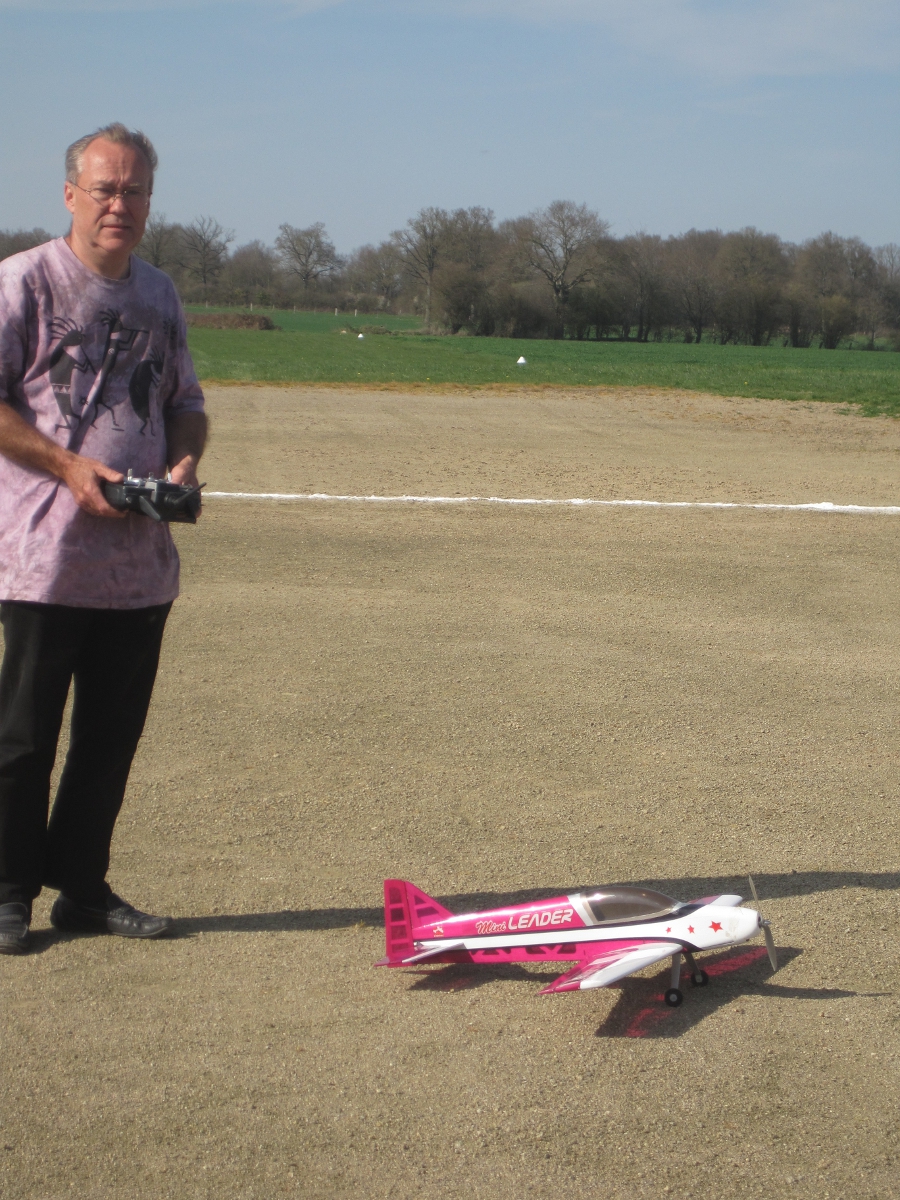
My plane is a "Mini Leader", described as a beginner's aerobatic plane, it has forgiving handling, and can be set up for serious aerobatics or for more gentle maneuvres. I have set it up for the latter. My purpose in flying it yesterday was to verify the trim, and to confirm I could still get an aeroplane off the ground and back down again in one piece. The wind made things difficult, but the first out-and-back trip was fine. The second one, a gust took it during landing, and the impact made the wheels come off. Nothing that a spot of glue won't fix. But flying is one of those things that is unforgiving of errors of judgement. Given the wind I should have kept it on the ground.
Later, I took my flying bug into flyng full-sized aeroplanes and gliders, followed by hang-gliders and parapentes. Although I was convinced at age thirteen that I was going to fly for a living, the passion never really bit beyond the level of enthusiasm, and I did different things with my working life. My interest in flying still remains, though, and now, having the means to acquire a radio control system, I have a couple of model aircraft that I fly from time to time when the weather and spare time permit.
Modern technology has advanced model aircraft a long way since I was a lad. It is nearly impossible to buy a "bad" plane: they are well-designed, and a model will, if correctly put together, usually do "what it says on the tin". The latest, lithium-polymer battery technology gives good power-to-weight, and combined with new, powerful ("brushless") electric motors, electric powered models are a realistic proposition. You can also buy models that are "Almost Ready to Fly", which means that instead of starting with a few sheets of balsa wood and heat-shrink covering, the main elements are already built: You just have to put the pre-built wings, tail, fuselage together, and add the electronics and mechanisms. This suits me fine, but one day I think I'll build one from scratch, like I used to.
I have little interest in aerobatic stunts: I dont get excited by the possibility of performing a perfect loop, Immelmann turn or the like, though I appreciate the precision of control need for it. Nor am I especially interested in building and flying scale models of real aircraft. Mostly I enjoy flying model gliders; I like the skill in flying close to the edge of what a plane will do, minimising lost height in a turn, looking for the invisible rising currents of air that will keep a plane flying for hours using only wind energy.
By chance, I discovered that a local model flying club has its workshop in the same building as we have our Franch lessons, so I introduced myself. Yesterday for the first time in a couple of years, I took my little "general purpose" plane out for a spin, at their flying field near Jublains. The wind was a bit blustery, not ideal conditions for flying, but I decided to fly it anyway.
My plane is a "Mini Leader", described as a beginner's aerobatic plane, it has forgiving handling, and can be set up for serious aerobatics or for more gentle maneuvres. I have set it up for the latter. My purpose in flying it yesterday was to verify the trim, and to confirm I could still get an aeroplane off the ground and back down again in one piece. The wind made things difficult, but the first out-and-back trip was fine. The second one, a gust took it during landing, and the impact made the wheels come off. Nothing that a spot of glue won't fix. But flying is one of those things that is unforgiving of errors of judgement. Given the wind I should have kept it on the ground.
Tuesday, 20 March 2012
Springtime
Time to plan the gardening year, review the projects, and wonder what happened to all that time you were going to have in Winter to fix the mower, clear the new flower beds, dig in compost, and so on. Because now it's too late, of course: now is the season of sprouting things that will die or fail to flourish if you don't attend to them.
I have a few new things for this year. One is a policy to be ruthless in only planting seeds for the number of plants I want, especially veg plants. There's usually more seed than I need in a packet, but it seems a shame not to plant them all, and besides, they might not all germinate so I might not end up with enough. And then you have a tray full of seedlings, and it seems callous not to pot them on, after all I encouraged them into life in the first place, did I not? And so on, until you are faced with more squash than you can eat before they rot, or nowhere in the veg patch to put them, so you're pleading with friends to take them..... So this year, I'm going for more variety, but smaller quantities, and hang the cost of the seeds.
Secondly, a new technique for saving money, or at least for spending less of it, which is not quite the same thing. Not that I'm cheap, but I just don't like waste. So this year's harvest of toilet roll inner tubes is being pressed into service as substitutes for peat pots. The value in these things is that you plant the pot (or roll) directly into the ground without having to take the plant out of a pot, so the roots are not disturbed. Good for certain plants that don't take kindly to disturbance, or have tap roots that go deep.
And yet another try at getting perennial poppy seeds to germinate. I'm sure I could have bought several big, established plants with the money I have wasted on seeds so far, but this year I am trying something radical: I'm following the instructions on the packet.
New begonias bought this year are mixing it with ones overwintered from last year. I wonder if they'll grow. I have ruthlessly cut down the number of Brussels Sprout seeds I planted, since I figure I only need about 6 plants. OK, so there's 15 here, but the slugs might get some.... and Leo can have the other tray of 15.
The traditional style peat pots are holding artichoke seedlings. The modern high-economy ones are holding dwarf lupins and normal tall lupins. I wonder how I'll remember which are which.
I have a few new things for this year. One is a policy to be ruthless in only planting seeds for the number of plants I want, especially veg plants. There's usually more seed than I need in a packet, but it seems a shame not to plant them all, and besides, they might not all germinate so I might not end up with enough. And then you have a tray full of seedlings, and it seems callous not to pot them on, after all I encouraged them into life in the first place, did I not? And so on, until you are faced with more squash than you can eat before they rot, or nowhere in the veg patch to put them, so you're pleading with friends to take them..... So this year, I'm going for more variety, but smaller quantities, and hang the cost of the seeds.
Secondly, a new technique for saving money, or at least for spending less of it, which is not quite the same thing. Not that I'm cheap, but I just don't like waste. So this year's harvest of toilet roll inner tubes is being pressed into service as substitutes for peat pots. The value in these things is that you plant the pot (or roll) directly into the ground without having to take the plant out of a pot, so the roots are not disturbed. Good for certain plants that don't take kindly to disturbance, or have tap roots that go deep.
And yet another try at getting perennial poppy seeds to germinate. I'm sure I could have bought several big, established plants with the money I have wasted on seeds so far, but this year I am trying something radical: I'm following the instructions on the packet.
New begonias bought this year are mixing it with ones overwintered from last year. I wonder if they'll grow. I have ruthlessly cut down the number of Brussels Sprout seeds I planted, since I figure I only need about 6 plants. OK, so there's 15 here, but the slugs might get some.... and Leo can have the other tray of 15.
The traditional style peat pots are holding artichoke seedlings. The modern high-economy ones are holding dwarf lupins and normal tall lupins. I wonder how I'll remember which are which.
Subscribe to:
Posts (Atom)